
Johnston County Court Records After Arrest
A jail arrest starts with custody and booking through local law enforcement, including the Johnston County Sheriff's Office led by Sheriff Steve Bizzell, but the court record is maintained by the North Carolina Judicial Branch and the Johnston County Clerk of Superior Court. The roster can show who is currently housed in the jail and the public booking charge. The recent arrest search can show short-window arrest details and may include bond amount and bond type. The court record is the formal case file path for charges filed in court, hearings, dispositions, judgments, and public case events.
Johnston County is an eCourts county. The NC Judicial Branch Johnston County page identifies Prosecutorial District 13, Superior Court District 13, and District Court District 12. It links to court dates, calendars, services, and the Portal. The same court system is separate from the Sheriff's Office roster. Custody and booking details belong with Johnston County jail inmate records, while booking photos belong with the Johnston County jail mugshots topic.
The prosecutor's role is also separate from the jail. Johnston County is served by District Attorney Jason T. Waller in Prosecutorial District 13, according to current Judicial Branch and district-attorney lookup research. After arrest, the District Attorney may pursue, dismiss, amend, reduce, or indict charges depending on the case posture and evidence. That is why a jail roster charge can differ from the charge that later appears in the court record.
Find Johnston County Court Records After Arrest
The online case path is the NC eCourts Portal. The public can use Portal without registration to search publicly available court information. Registration allows features such as saved cases, but it does not create access to restricted records. Elevated access is limited to users with verified authority by statute. For a person arrested in Johnston County, narrow the search to Johnston County when that filter is available.
- Open the NC eCourts Portal and use Smart Search for public case summaries and registers of actions.
- Search by defendant name in last, first middle suffix format, or by case number if known.
- Use location, case type, case status, filing date, party, or DOB filters when available to narrow Johnston County results.
- Open the case summary and read the case events, hearings, dispositions, party information, and financial entries if public.
- Use Search Hearings for court-date checks by case number, party name, attorney, judicial officer, or courtroom.
- If Portal does not answer the question, use a clerk public terminal or contact the Johnston County Clerk of Superior Court.
The official Portal training page documents Smart Search, Search Hearings, advanced filters, registration, and elevated access limits.
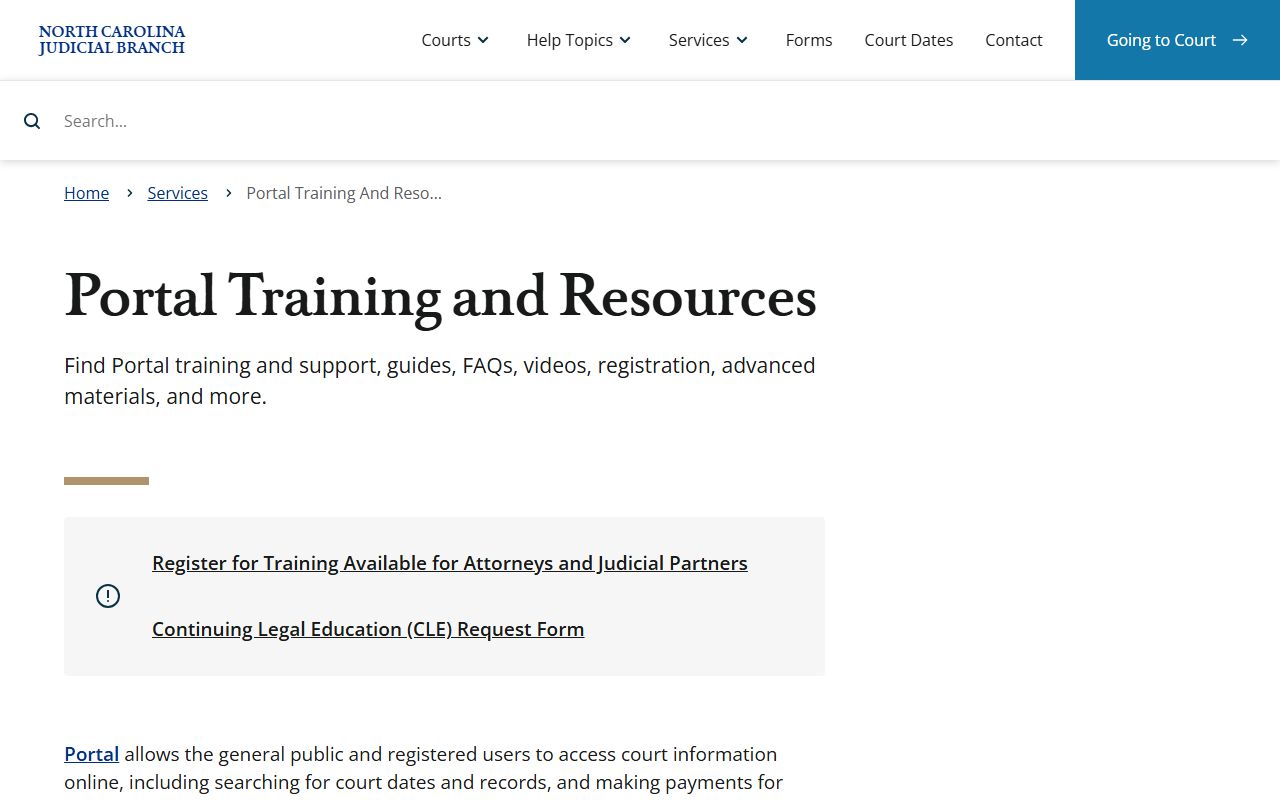
The training material is important because it confirms that public search is available without treating registration as a way around sealed or restricted access.
Johnston County Court Search Fields
Portal search works best when the jail booking data is used as a clue, not as the final court record. The jail roster may provide name, arrest date, and a charge phrase. Portal and the clerk can then show whether a public court case exists, whether the charge changed, and which hearings or dispositions have been posted.
| Field Label | Type | Required | Notes |
|---|---|---|---|
| Smart Search | Search mode | Not applicable | Provides case summary and register of actions for public records. |
| Record Number or Name | Text | One criterion needed | Use case number or name in Last, First Middle Suffix format. |
| Location | Filter | Optional | Use Johnston County to narrow local cases. |
| Party Name / DOB | Advanced party filters | Optional | Helpful when names are common. |
| Case Type / Status | Advanced case filters | Optional | Can narrow criminal, status, or other case categories where exposed. |
| Case Filing Date Range | Date filters | Optional | Useful when the arrest date is known but the case number is not. |
| Search Hearings | Hearing search | Optional | Search by case number, party, attorney, judicial officer, or courtroom. |
Johnston County Clerk Court Records
The clerk fallback remains important. The NC Judicial Branch court-records help topic says criminal case information can be accessed at public self-service terminals in clerk offices, and a terminal can search by defendant name, case number, or victim/witness name. Paper files may be available at the clerk's office in the county where the case is located, and copies may involve a fee. For background checks, the Judicial Branch says individuals should use the county clerk's office, not Portal alone.
Johnston County Courthouse
207 E. Johnston Street
Smithfield, NC 27577
919-209-5400
Monday through Friday, 8:00 a.m. to 5:00 p.m.
Johnston County District Attorney
125 S. Second Street
Smithfield, NC 27577
919-209-5520
Prosecution office for Prosecutorial District 13.
Charging Documents After Johnston Arrest
A booking charge is the arrest-side description. The court charge is the formal charge that appears after filing, amendment, indictment, or disposition. North Carolina practice can involve warrants, criminal summons, indictments, and other filed documents. The research specifically calls out returned arrest and search warrants, indictments, criminal summons, and nontestimonial identification orders as public court records unless sealed by court order under G.S. 132-1.4.
| Document | Who Uses It | What It Means for the Court Record |
|---|---|---|
| Complaint or magistrate process | Officer, magistrate, or prosecutor depending on posture | Starts or supports the initial criminal accusation after arrest. |
| Information | Prosecutor | Formal charging document used in some prosecutions when allowed by procedure. |
| Indictment | Grand jury | Formal felony accusation that can replace or refine earlier arrest charges. |
Because the prosecutor can amend, reduce, dismiss, or seek indictment, the court record should be checked after the jail booking. A roster row is not a conviction record and is not the final legal status of the case.
Johnston County Charge Status Terms
Charge status changes as a case moves through court. A pending charge means the case has not reached a final disposition. An amended charge has changed from the original filing. A reduced charge may replace a more serious allegation. A dismissed charge ends without conviction. A conviction is a plea or finding of guilt, not just an arrest or booking event.
| Status | What It Means |
|---|---|
| Pending | The charge or case remains active and has not been finally disposed. |
| Amended | The charge changed through prosecutor or court action. |
| Reduced | A lesser charge was substituted or accepted. |
| Dismissed | The charge ended without conviction. |
| Disposed | The court entered a final result for that charge or case. |
| Conviction | A formal guilty plea or finding, separate from the arrest itself. |
| Indictment | A formal felony accusation by a grand jury. |
Bond After Johnston County Arrest
Bond and release start at the magistrate or court stage. JCSO's Detention Center FAQ says charge and bond information can be obtained by calling the Clerk's Office at 919-209-5400 or the jail at 919-989-5040 and providing the inmate's full name. For release requirements, the FAQ directs callers to the Magistrate's Office at 919-209-5463 or to a bondsman. It does not publish a private bondsman list online for endorsement.
| Release Type | How It Works | Practical Johnston County Channel |
|---|---|---|
| Written promise | Release based on a promise to appear. | Set by judicial official; verify with clerk or magistrate. |
| Unsecured bond | Money is owed only if conditions are violated. | Clerk, magistrate, or jail can confirm terms. |
| Secured bond | Cash, mortgage, or surety must secure release. | Call Magistrate's Office at 919-209-5463 for release requirements. |
| Surety bond | A bondsman or other surety guarantees appearance. | JCSO says a list is displayed in the Magistrate's Office. |
| No-bond or hold | Release is blocked until a judge or holding agency acts. | Check jail, clerk, magistrate, and the holding agency if one exists. |
Warrants and Court Records After Arrest
No official online Johnston County active-warrant search was found in the researched JCSO pages. The official channels are phone, court search, and records request paths. JCSO's patrol page says deputies serve court orders including warrants for arrest, subpoenas, summonses, domestic-violence orders, and other court-related documents. The contact page lists Criminal Process Inquiries at 919-989-5772 and Civil Process Inquiries at 919-989-5023.
If a warrant is served and the person is booked, the current roster may later show a charge or hold phrase. It does not display a warrant number, issuing judge, issuing court, or full warrant status. Better warrant-related sources are the Clerk of Superior Court, Magistrates - Criminal at 919-209-5462, JCSO criminal process, Portal, and clerk terminals. Returned warrants can become public court records unless sealed.
Charges and Convictions Compared
A Johnston County arrest record, jail roster entry, and court case record should not be read as the same thing. The arrest record documents custody and alleged violation at booking. The court record tracks the charge once filed and processed. A conviction exists only after a guilty plea, verdict, or other final court result that counts as a conviction.
| Issue | Charge | Conviction |
|---|---|---|
| Stage | Allegation or filed accusation. | Final guilty plea or finding. |
| Where Seen | Roster, recent arrest result, Portal, or clerk record. | Court disposition, judgment, or criminal-history record. |
| Can Change | Yes, it may be amended, reduced, or dismissed. | May change only through court action, appeal, correction, or relief. |
| Use Caution | Not proof of guilt. | Still verify case identity and final status with official court records. |
Sealed and Expunged Records
Some court records after an arrest may be restricted by statute, court order, juvenile rules, or expunction. North Carolina's public-records law makes many arrest facts and court records public, but criminal investigation records are treated differently under N.C. G.S. 132-1.4. Returned warrants and indictments are public court records unless sealed by court order. Public access can also change when an expunction is granted.
| Issue | Sealed | Expunged |
|---|---|---|
| Public visibility | Hidden from ordinary public access by law or order. | Removed or treated as not existing for many legal purposes after proper order. |
| Process | Depends on court order, statute, or restricted record category. | Requires eligibility and court process under North Carolina expunction law. |
| Official source | Clerk of Superior Court or court order. | NC Judicial Branch expunction process and clerk record. |
For eligible record-clearing questions, use the NC Judicial Branch expunction topic and the clerk's office. Do not assume that a dismissed charge has disappeared from every public index without checking the court record.
Public Records After Jail Arrest
North Carolina public-records statutes explain why some information is public and some is not. N.C. G.S. 132-1 defines public records broadly. N.C. G.S. 132-6 governs inspection and copying. N.C. G.S. 132-1.4 protects criminal investigation records while making basic arrest information public.
For judicial records, the NC Judicial Branch provides Portal, clerk terminals, and public-record request routes. For Sheriff's Office booking or arrest records not online, Johnston County's public-records form can be used with Sheriff's Office selected. The best source depends on the record type: custody records at the jail, court charges at the clerk or Portal, prosecution questions at the DA, and state prison status at NC DAC.